


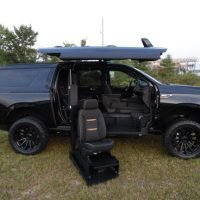


Cargo Flexibility in Large Mobility SUVs
See how large wheelchair-accessible SUVs accommodate changing cargo needs while supporting family outings, road trips, and everyday independence.

Weather plays a larger role in mobility than many people realize, especially for drivers and passengers who rely on wheelchair lifts every day. Rain, snow, heat, and cold all interact with mechanical and hydraulic systems in different ways, sometimes subtly and sometimes very noticeably.
Understanding how weather affects wheelchair lift performance helps wheelchair users feel better prepared, more confident, and more in control when conditions change. Reliable access to a vehicle supports independence and the freedom to keep living life on your terms. Similarly, access to a reliable wheelchair-accessible vehicle built to handle the elements with ease enables your safe transport to work, to the grocery store, or to a friend’s place, and can make all the difference. With the right knowledge and equipment, seasonal challenges become manageable rather than limiting.
“All-weather use” means wheelchair lifts are designed to operate reliably across changing seasons, not that weather has no effect at all. Real-world conditions introduce variables that influence performance over time. Well-engineered lift systems account for these factors through durable materials and a tested design. Understanding this distinction helps users approach seasonal changes with confidence rather than concern.
Cold temperatures change how hydraulic systems behave. Fortunately, ATC Mobility takes that into account and leverages Automatic Transmission Fluid (ATF) to power its wheelchair lift. The viscosity of ATF allows it to flow smoothly through the various size valves within the system while maintaining its molecular integrity.This fluid has less of a tendency to thicken in lower temperatures, so the lift movement will feel smoother and less choppy during the winter months.
Winter weather introduces physical challenges beyond temperature alone. Ice can form on platforms, hinges, and tracks, creating resistance that reduces component smoothness. Snow can settle into crevices or around moving parts, and slush from the road may refreeze after the vehicle is parked. These conditions can affect how easily the lift deploys or retracts, especially after storms or long drives on winter roads.
Cold-weather driving exposes the vehicle to road salt, sand, and other debris that accumulate beneath it. These materials can interact with metal components and moving parts over time, especially when combined with moisture and freezing temperatures. Salt, in particular, accelerates natural wear processes, making winter one of the more demanding seasons for any mobility equipment.
 How Hot Weather Affects Wheelchair Lift Performance
High temperatures place different demands on hydraulic systems than cold weather does. Heat can increase internal pressure in the system, highlighting any existing wear in seals, hoses, or fittings. While lifts are engineered to operate across a wide temperature range, extreme heat can make the system feel more sensitive to prolonged use or extended exposure to direct sunlight.
Metal naturally expands when exposed to heat, and repeated cycles of expansion and contraction contribute to long-term wear at connection points. In well-engineered systems, these effects are accounted for in the design, but the physics remain the same: hot weather accelerates certain aging processes. Over many seasons, this can influence how components align and interact, especially in systems that already have some mileage on them.
Wheelchair lifts are built to handle everyday rain and splashes from the road. Their materials and construction provide sufficient water resistance for normal driving conditions. However, prolonged or heavy moisture exposure, such as standing water, repeated saturation, or trapped humidity, can gradually influence how mechanical and structural components behave. Over time, moisture can seep into areas that are otherwise protected during typical use.
Modern lift systems rely on electrical controls, sensors, and wiring that are sealed against the elements. Moisture becomes a concern when seals age or when humidity persists over long periods. Water intrusion can interfere with electrical signals or contribute to corrosion in sensitive areas. These effects tend to develop gradually, often becoming noticeable only after extended exposure to wet or humid environments.
 How ATC Mobility Designs Lifts for All-Season Reliability
ATC Mobility builds conversions with extreme seasonal conditions in mind, recognizing that independence does not pause for the weather. We engineer our hydraulic lift systems to perform consistently across varied climates and driving environments.
Protective design elements and careful integration support reliability in daily use. ATC Mobility conversions prioritize confidence, whether navigating winter roads or summer heat. Drivers choosing wheelchair SUV conversions benefit from systems designed to support active lifestyles without compromising access, comfort, or safety year-round.
Seasonal conditions place different demands on wheelchair lift systems, which makes proactive maintenance essential for long-term reliability. Focusing on seasonal care helps preserve smooth operation and supports confidence throughout the year.
Along with the seasonal tips above, year-round inspections and scheduled professional servicing are key to keeping hydraulic, mechanical, and electrical components performing at their best.
Certain changes should never be ignored. Slower movement, unusual noises, inconsistent control response, or visible corrosion suggest the need for professional evaluation. Addressing concerns early reduces safety risks and prevents more extensive repairs. Reliable service restores confidence and keeps daily routines uninterrupted.
Weather doesn’t define mobility; preparation and thoughtful design do. Understanding how weather affects wheelchair lift performance enables wheelchair users to move through changing seasons with confidence rather than hesitation. With equipment built for real-world conditions and an awareness of how environments interact with performance, independence remains steady year-round. ATC Mobility exists to support that freedom, so daily life never has to slow down because the forecast changed.


