


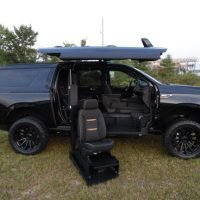


Cargo Flexibility in Large Mobility SUVs
See how large wheelchair-accessible SUVs accommodate changing cargo needs while supporting family outings, road trips, and everyday independence.

For a wheelchair user, where they ride inside a vehicle affects much more than comfort. Seating position can influence visibility, communication, securement, and how naturally the person can take part in each trip. A front-seat conversion brings the wheelchair user into the same part of the cabin where a conventional driver or front passenger would sit.
When engineered and tested correctly, front-seat wheelchair conversions are safer than their alternatives. Keep reading to understand why.
A wheelchair-accessible vehicle should provide more than a way in and out. The seating location must also work with the vehicle’s controls, visibility, and occupant-protection systems.
Placing the wheelchair user in the front seating area preserves a familiar cabin layout. A driver can face forward from the expected driving position, while a front passenger can stay close to the driver and remain engaged with what is happening on the road.
Drivers rely on a clear view of traffic, mirrors, road markings, and nearby obstacles. A front-seat conversion places a wheelchair user who drives in the area for operating the vehicle.
Converters can then configure adaptive driving equipment around that position based on the individual’s needs. Exact equipment and fit vary from one driver to another, which makes professional evaluation and installation an important part of the process.
A wheelchair user who rides as a passenger can also benefit from being near the driver. Conversation feels natural, and the passenger has a direct view of the road ahead.
For caregivers or family members, the arrangement can make communication easier during the trip. The wheelchair user remains part of the same immediate cabin experience as the people traveling with them.
Seat location alone does not make a conversion safe. Wheelchair securement, occupant restraints, structural engineering, and conversion quality all contribute to occupant protection.
The National Mobility Equipment Dealers Association (NMEDA) emphasizes the importance of attaching wheelchair locking mechanisms and tiedowns to appropriate securement points and positioning floor anchors correctly. Proper securement helps stabilize a wheelchair being used as a seat during vehicle travel.

In a wheelchair-accessible SUV, the chair becomes part of the occupant’s seating environment when the person stays during the trip. Securement therefore deserves the same careful attention as other major safety components.
ATC Mobility uses a hydraulic lift to bring the wheelchair and user into the vehicle. If the user chooses to ride in their wheelchair, it must first spacially fit on the lift and align with the securement and restraint equipment for the individual configuration.
Wheelchair dimensions vary, especially between manual and power chairs. ATC Mobility uses detailed measuring guides to determine whether a chair can fit the lift and interior space before a conversion moves forward.
Careful measurement supports appropriate clearance and positioning. It also gives the conversion team the information to determine whether the vehicle configuration suits the wheelchair user.
Changing a factory vehicle requires careful engineering because accessibility modifications can affect the vehicle’s structure and interior configuration. Buyers should therefore look beyond convenience features and ask how a completed conversion has been evaluated.
ATC Mobility’s large SUV conversions are all federally crash-test approved. We always emphasize structural reinforcement and safety validation in our approach to converting vehicles.
A factory truck or SUV begins with the manufacturer’s original structure. Accessibility modifications may change parts of the floor or surrounding structure, so the converter must account for those changes during the design process.
Crash testing evaluates how a modified vehicle performs under defined test conditions. As with factory vehicles, testing cannot eliminate every risk on the road, but it gives buyers meaningful information to consider when evaluating a conversion.
ATC Mobility currently converts select Chevrolet and GMC trucks and large SUVs. The construction of those vehicles provides the floor strength necessary to support our lift system, wheelchair, and rider while maintaining conversion requirements.
Choosing a compatible platform matters because accessibility equipment becomes part of the finished vehicle. The base vehicle and conversion must work together as a complete system.
Getting into a vehicle can present difficulties before the engine starts. Some wheelchair users may otherwise need to transfer to a factory seat or depend on another person for physical assistance.
While ATC offers the option to transfer to the OEM seat, their system also offers the option to remove that seat and back their wheelchair directly onto the hydraulic lift and remain in their wheelchair for the ride. The lift raises the wheelchair into the cabin, where the user can prepare for travel without completing another seat-to-seat transfer.

Reducing transfers can remove a physically demanding part of vehicle entry. For users with limited strength or balance, staying in the wheelchair makes the process easier to manage.
Caregivers may benefit as well because the process can require less lifting and repositioning. Meanwhile, the wheelchair user can retain greater control over how they enter the vehicle.
ATC Mobility offers both driver-side and passenger-side conversions. For a qualified wheelchair user who drives, a driver-side configuration creates a direct path from the lift to the driving position.
Adaptive controls may still be necessary depending on the driver’s abilities. A mobility specialist can help determine which equipment suits the driver and the converted vehicle.
Accessibility can affect the whole family, particularly when a conversion changes where people can sit. ATC Mobility’s SUV conversions maintain the original vehicle seating while accommodating the wheelchair user’s position, including three-row configurations.
A front-position conversion integrates the wheelchair into the cabin while preserving rear seating for other passengers. Families can travel together without separating the wheelchair user from the main activity inside the vehicle.
Comfort and safety connect closely when someone spends significant time behind the wheel. Good visibility, appropriate control placement, and secure wheelchair positioning can help create a suitable driving environment for the individual.
Proper fit remains personal. Converters must consider wheelchair dimensions, adaptive equipment, reach, and individual mobility needs before finalizing the vehicle.
While front-seat wheelchair conversions are safer, not every conversion is the same. Prospective buyers should evaluate the complete conversion, not one feature in isolation. Ask about crash testing and how the vehicle secures the wheelchair. Buyers should also find out how the converter verifies wheelchair dimensions before beginning the build.
Professional fitting matters after the main conversion as well. ATC Mobility can send completed vehicles to a local mobility dealer for final adaptations based on the user’s needs.
Front-seat wheelchair conversions can combine accessibility with a driving or riding position that feels familiar and cohesive. Their safety advantages depend on sound engineering, tested vehicle modifications, correct securement, and a precise fit for the wheelchair user.
ATC Mobility builds converted Chevrolet and GMC trucks and SUVs for wheelchair users who want greater access while keeping the vehicle experience they prefer. Contact ATC Mobility to discuss your wheelchair measurements, preferred seating position, and conversion options for safe, confident travel.


